 En
En  Ar
Ar UN and Humanitarian Personnel in Yemen Face Escalating Campaign of Arrests and Intimidation
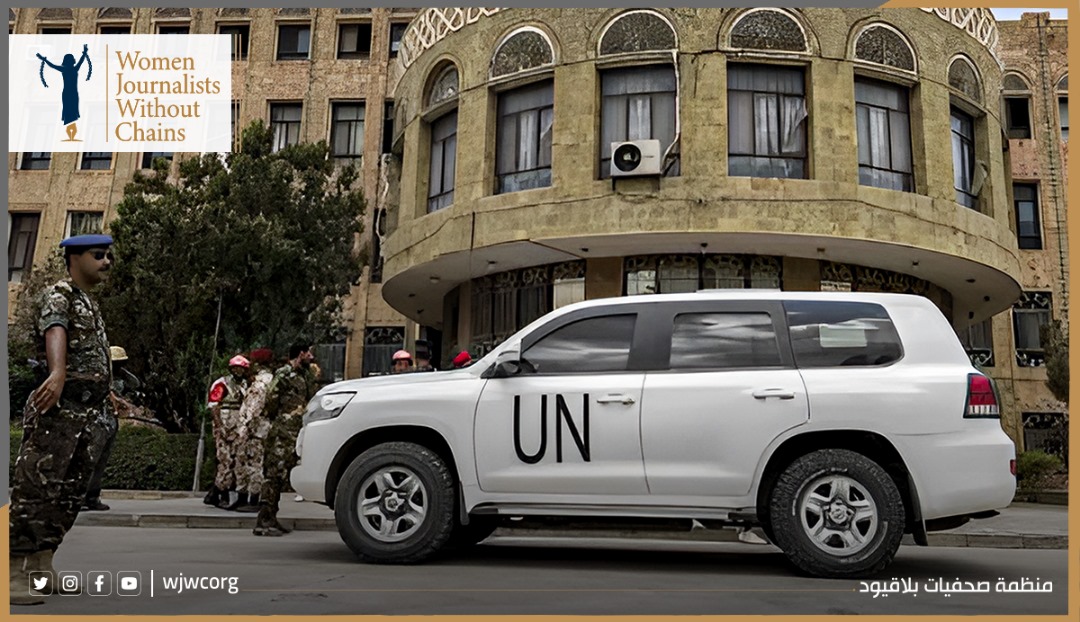
A growing number of United Nations and humanitarian workers in Yemen remain in detention or forcibly disappeared following a renewed escalation by Houthi forces, raising serious concerns over the safety of humanitarian operations and the systematic erosion of international legal protections for aid workers.
According to documentation by Women Journalists Without Chains, Houthi security elements carried out a series of coordinated arrests on December 18 and 19, 2025, targeting UN employees in Sana’a through armed home raids conducted during the early morning hours. At least twelve staff members working with UN agencies were abducted and transferred to undisclosed locations, with no official charges disclosed and no contact permitted with their families.
The raids were executed simultaneously in multiple residential neighborhoods of the capital, involving armored vehicles and mixed-gender security units. Armed personnel sealed off entire neighborhoods, blocked entrances and exits for several hours, and positioned snipers or armed guards on rooftops. Homes were subjected to prolonged searches, and personal belongings were confiscated.
Women Journalists Without Chains described these actions as grave violations of the inviolability of private homes and the right to privacy, as well as a breach of the privileges and immunities guaranteed to United Nations staff under international law.
UN Agencies and Functions Targeted
Those abducted were employed by the World Food Programme (WFP), the United Nations Development Programme (UNDP), and the United Nations Department of Safety and Security (UNDSS). The arrests encompassed a broad range of professional roles, including logistics officers, program managers, drivers, medical staff, and field security personnel, indicating a deliberate targeting of core operational staff essential to humanitarian delivery.
The abducted individuals were identified as:
• Ahmed Hassan Hamid Al-Din, Logistics and Support Services Officer, WFP
• Nasser Mohammed Al-Khawlani, Program and Project Management Officer, WFP
• Aziz Ahmed Al-Jaradi, Driver, WFP
• Zaher Derhim Sallam Al-Dali, Driver, WFP
• Marwan Omar Jaradah, Driver, WFP
• Fathi Mohammed Omar Al-Ahdal, Former Driver, WFP
• Dr. Mohammed Abdul Latif Abdulmugni, Clinic Doctor, UNDP Sana’a
• Majid Mohammed Ali Al-Sayaghi, Driver, UNDP Sana’a
• Imad Hamid Al-Sharif, Driver, UNDSS Sana’a
• Mohammed Saleh Al-Dhebi, Field Security Assistant, UNDSS Sana’a
• Maamoun Mohammed Ali Shujaa Al-Din, Driver, WFP
• Suleiman Al-Ghuwaizi, Driver, WFP
Family Members Also Targeted
Women Journalists Without Chains highlighted the case of Dr. Mohammed Abdul Latif Abdulmugni, who was arrested from his home in front of his children. His abduction followed the earlier detention of his wife, Hanan Al-Shaibani, a WFP employee, who had been held for weeks prior. The organization characterized the incident as part of a deliberate pattern of collective punishment and family-based targeting, designed to exert psychological pressure and enforce compliance.
Families of all detainees remain unable to communicate with their relatives and have received no information regarding their health conditions or places of detention.
Detentions Linked to Broader Repressive Strategy
Women Journalists Without Chains reported that these arrests form part of a sustained and organized campaign against humanitarian workers. Based on UN figures cited by the organization, approximately 69 UN staff members are currently detained by Houthi authorities.
The organization noted that on December 7, 2025, Houthi-controlled judicial bodies initiated proceedings against 12 detainees, including three UN employees, in trials that failed to meet basic international standards of due process. In November 2025, death sentences were issued against 17 individuals in what Women Journalists Without Chains described as illegitimate and pre-determined trials.
Statements by the militia leader accusing humanitarian workers of espionage for foreign governments, including the United States and Israel, were cited as evidence of a deliberate effort to criminalize humanitarian activity and preemptively frame detainees as defendants in show trials.
Families Issue Urgent Appeal
The Preparatory Committee of the Association of Families of Detained and Disappeared Humanitarian Workers submitted an appeal to the sponsors of Yemeni consultations in Oman and to the Office of the UN Special Envoy. The committee confirmed the continued incommunicado detention of UN and humanitarian staff in Sana’a and warned that families remain entirely uninformed about the fate of their relatives.
The committee called for immediate disclosure of detainees’ whereabouts, unrestricted family contact, and the unconditional release of all those detained, warning that continued inaction endangers lives and threatens the sustainability of humanitarian assistance across Yemen.
Crimes Against Humanity Under International Law
Women Journalists Without Chains concluded that the cumulative pattern of armed raids, arbitrary detention, enforced disappearance, denial of communication, torture, mistreatment, psychological coercion, and referral to trials with pre-arranged outcomes constitutes a widespread and systematic attack against a protected civilian group.
The organization stated that these acts meet the criteria for crimes against humanity under Article 7 of the Rome Statute of the International Criminal Court, emphasizing that such crimes are not subject to statutes of limitation and entail individual criminal responsibility for both perpetrators and those in positions of command.
Calls for Immediate International Action
Women Journalists Without Chains condemned the arrests and detentions in the strongest terms and held the Houthi militia fully responsible for the safety and well-being of all detainees.
The organization demanded the immediate and unconditional release of all arbitrarily detained UN and humanitarian personnel, disclosure of the fate of the disappeared, guarantees of access to families and legal representation, the termination of all show trials, and the annulment of unlawful sentences.
It urged the United Nations, the Security Council, member states, and relevant international accountability mechanisms to take urgent and concrete measures to protect humanitarian workers in Yemen and to ensure that those responsible for these violations are held accountable.
The organization expressed solidarity with the families of the detainees, warning that continued international silence or negligence risks undermining humanitarian principles and further endangering millions of civilians reliant on aid.