 En
En  Ar
Ar 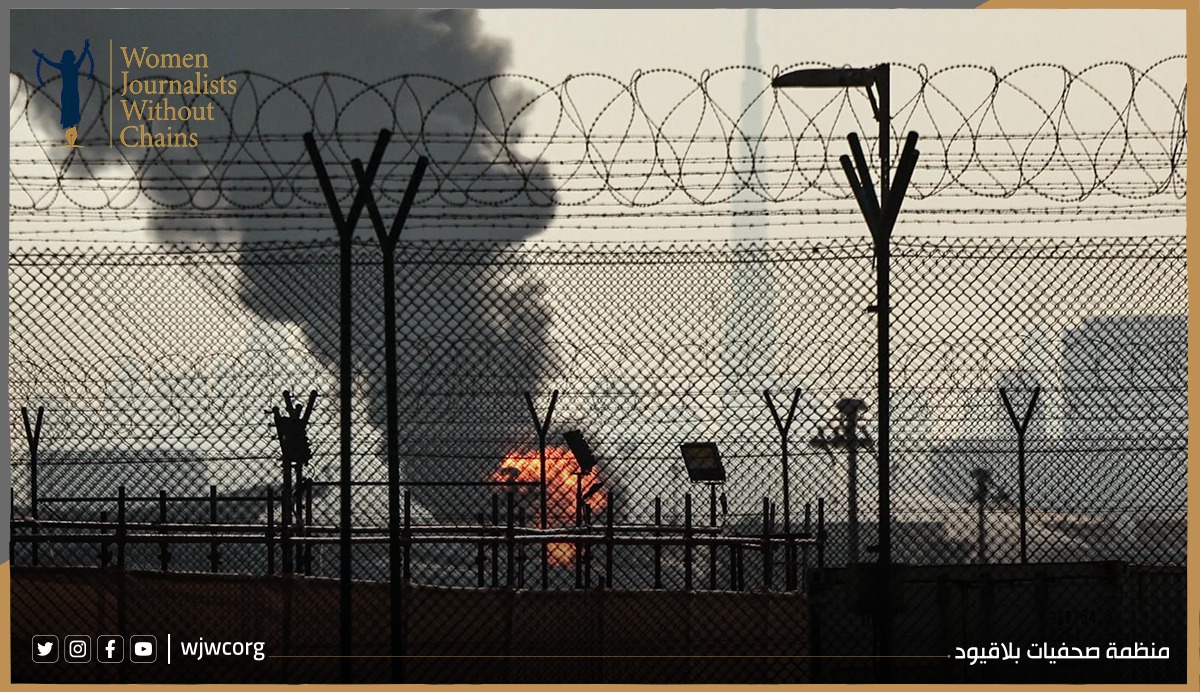
Geneva – March 26, 2026 – Women Journalists Without Chains has expressed deep concern over the arrest of more than 100 individuals, including tourists and residents, in the United Arab Emirates for documenting recent security developments and sharing related content online.
According to information monitored by the organization, security forces detained at least 109 individuals in Abu Dhabi between March 10 and 26, with additional arrests reported in Dubai and Fujairah. Those affected include citizens, residents, and foreign nationals.
The arrests appear to be linked to the publication of photos, videos, and online commentary documenting missile strikes and the country’s air defense responses during recent regional escalations involving Iran. Authorities have also targeted individuals for content deemed harmful to the state’s security image.
Women Journalists Without Chains documented cases in which individuals were detained for non-political activities, including photographing public locations during the period of heightened tensions. Among those affected were a 60-year-old British tourist, a domestic worker in Dubai, and a Vietnamese sailor in Fujairah.
Authorities have reportedly relied on broadly defined charges such as “spreading misinformation,” “inciting public fear,” and “undermining national defense capabilities.” The organization noted that much of the cited material consisted of spontaneous documentation of events occurring in public spaces.
Concerns have also been raised regarding due process. Available information indicates that some detainees were referred to expedited proceedings that lacked transparency and limited the ability of defendants to present an effective legal defense.
The organization observed that similar restrictions on online expression have emerged across the region since late February, particularly amid escalating geopolitical tensions. Measures targeting digital documentation have been reported in several Gulf countries, reflecting a wider contraction of civic space.
Women Journalists Without Chains stated that penalizing individuals for documenting events visible in public spaces signals an increasingly restrictive approach to information control, particularly during periods of public concern.
The organization emphasized that such measures are inconsistent with the United Arab Emirates’ obligations under international human rights law, including Article 19 of the Universal Declaration of Human Rights and the International Covenant on Civil and Political Rights, which guarantee the right to seek, receive, and share information.
It further raised concerns about the application of cybercrime and counterterrorism legislation, including Federal Decree-Law No. 34 of 2021 and Law No. 7 of 2014. The broad and ambiguous provisions contained in these laws, the organization noted, allow for their use in ways that may disproportionately restrict peaceful expression, including through custodial sentences and heavy financial penalties.
Women Journalists Without Chains stressed that security measures should not override fundamental freedoms, noting that access to information and transparency are essential to accountable governance.
The organization warned that restricting the documentation of public events risks creating an environment in which independent information is suppressed and public understanding is shaped solely by official narratives. It noted that civilian documentation has become an essential component of the modern information landscape.
Women Journalists Without Chains called on the UAE authorities to:
- Immediately and unconditionally release all individuals detained for documenting or sharing information about events in public spaces.
- Drop all charges related to peaceful digital expression, including those framed as “spreading rumors.”
- Amend cybercrime legislation to ensure greater legal clarity and prevent its use to restrict lawful expression.
- Ensure that any monitoring of personal devices is conducted in accordance with the law and subject to judicial oversight.
The organization stressed that these cases reflect a broader pattern of restricting access to information during sensitive periods. It called on the United Arab Emirates to ensure that its response to security developments is grounded in transparency, legal safeguards, and respect for fundamental freedoms.
Author’s Posts
-
Report Documents Escalating Arbitrary Detention, Enforced Disappearance, and Torture in Houthi-Controlled Areas
Women Journalists Without Chains has warned of a grave and accelerating surge in abductions, enforced disappearances, torture, and a...
May 13, 2026
-
Qahtan’s Enforced Disappearance: A Continuing Crime Demanding International Action
May 12, 2026
-
Israel’s War on Truth: Journalists and Medics Targeted in Lebanon
May 09, 2026
-
Protect Humanitarian Seas: Women Journalists Without Chains Condemns Flotilla Seizure
May 08, 2026
-
Statement on the Targeted Killing of Development Official in Aden
Related Articles